
Feishu/Lark is an all-in-one collaboration platform where teams chat, share documents, manage calendars, and get work done together. Status: production-ready for bot DMs + group chats. WebSocket is the default mode; webhook mode is optional.Documentation Index
Fetch the complete documentation index at: https://docs.openclaw.ai/llms.txt
Use this file to discover all available pages before exploring further.
Quick start
Requires OpenClaw 2026.4.25 or above. Run
openclaw --version to check. Upgrade with openclaw update.Run the channel setup wizard
Access control
Direct messages
ConfiguredmPolicy to control who can DM the bot:
"pairing"- unknown users receive a pairing code; approve via CLI"allowlist"- only users listed inallowFromcan chat (default: bot owner only)"open"- allow public DMs only whenallowFromincludes"*"; with restrictive entries, only matching users can chat"disabled"- disable all DMs
Group chats
Group policy (channels.feishu.groupPolicy):
| Value | Behavior |
|---|---|
"open" | Respond to all messages in groups |
"allowlist" | Only respond to groups in groupAllowFrom or explicitly configured under groups.<chat_id> |
"disabled" | Disable all group messages; explicit groups.<chat_id> entries do not override this |
allowlist
Mention requirement (channels.feishu.requireMention):
true- require @mention (default)false- respond without @mention- Per-group override:
channels.feishu.groups.<chat_id>.requireMention - Broadcast-only
@alland@_allare not treated as bot mentions. A message that mentions both@alland the bot directly still counts as a bot mention.
Group configuration examples
Allow all groups, no @mention required
Allow all groups, still require @mention
Allow specific groups only
allowlist mode, you can also admit a group by adding an explicit groups.<chat_id> entry. Explicit entries do not override groupPolicy: "disabled". Wildcard defaults under groups.* configure matching groups, but they do not admit groups by themselves.
Restrict senders within a group
Get group/user IDs
Group IDs (chat_id, format: oc_xxx)
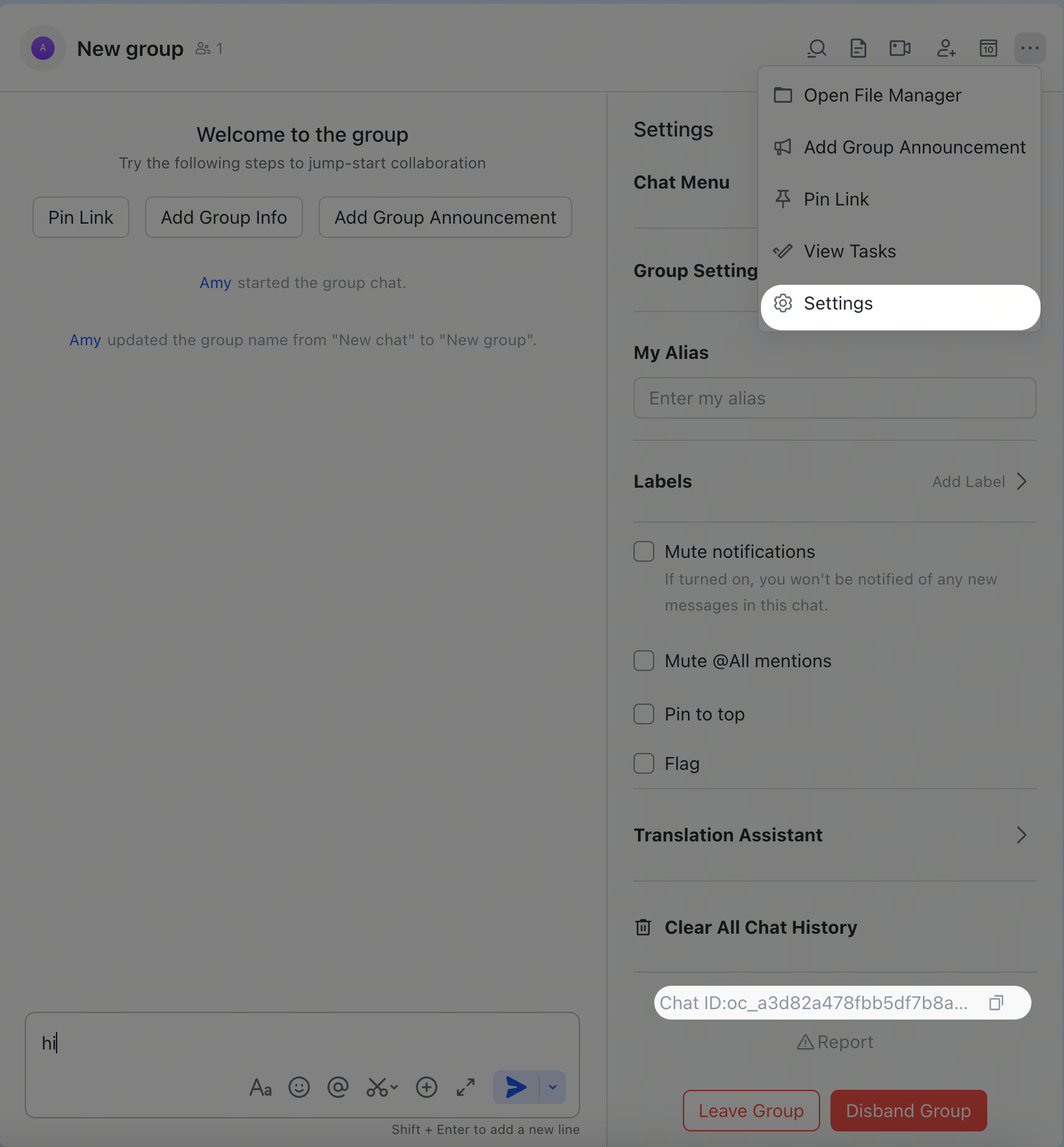
Open the group in Feishu/Lark, click the menu icon in the top-right corner, and go to Settings. The group ID (chat_id) is listed on the settings page.
User IDs (open_id, format: ou_xxx)
Start the gateway, send a DM to the bot, then check the logs:
open_id in the log output. You can also check pending pairing requests:
Common commands
| Command | Description |
|---|---|
/status | Show bot status |
/reset | Reset the current session |
/model | Show or switch the AI model |
Feishu/Lark does not support native slash-command menus, so send these as plain text messages.
Troubleshooting
Bot does not respond in group chats
- Ensure the bot is added to the group
- Ensure you @mention the bot (required by default)
- Verify
groupPolicyis not"disabled" - Check logs:
openclaw logs --follow
Bot does not receive messages
- Ensure the bot is published and approved in Feishu Open Platform / Lark Developer
- Ensure event subscription includes
im.message.receive_v1 - Ensure persistent connection (WebSocket) is selected
- Ensure all required permission scopes are granted
- Ensure the gateway is running:
openclaw gateway status - Check logs:
openclaw logs --follow
QR setup does not react in the Feishu mobile app
- Rerun setup:
openclaw channels login --channel feishu - Choose manual setup
- In Feishu Open Platform, create a self-built app and copy its App ID and App Secret
- Paste those credentials into the setup wizard
App Secret leaked
- Reset the App Secret in Feishu Open Platform / Lark Developer
- Update the value in your config
- Restart the gateway:
openclaw gateway restart
Advanced configuration
Multiple accounts
defaultAccount controls which account is used when outbound APIs do not specify an accountId.
accounts.<id>.tts uses the same shape as messages.tts and deep-merges over
global TTS config, so multi-bot Feishu setups can keep shared provider
credentials globally while overriding only voice, model, persona, or auto mode
per account.
Message limits
textChunkLimit- outbound text chunk size (default:2000chars)mediaMaxMb- media upload/download limit (default:30MB)
Streaming
Feishu/Lark supports streaming replies via interactive cards. When enabled, the bot updates the card in real time as it generates text.streaming: false to send the complete reply in one message. blockStreaming is off by default; enable it only when you want completed assistant blocks flushed before the final reply.
Quota optimization
Reduce the number of Feishu/Lark API calls with two optional flags:typingIndicator(defaulttrue): setfalseto skip typing reaction callsresolveSenderNames(defaulttrue): setfalseto skip sender profile lookups
ACP sessions
Feishu/Lark supports ACP for DMs and group thread messages. Feishu/Lark ACP is text-command driven - there are no native slash-command menus, so use/acp ... messages directly in the conversation.
Persistent ACP binding
Spawn ACP from chat
In a Feishu/Lark DM or thread:--thread here works for DMs and Feishu/Lark thread messages. Follow-up messages in the bound conversation route directly to that ACP session.
Multi-agent routing
Usebindings to route Feishu/Lark DMs or groups to different agents.
match.channel:"feishu"match.peer.kind:"direct"(DM) or"group"(group chat)match.peer.id: user Open ID (ou_xxx) or group ID (oc_xxx)
Configuration reference
Full configuration: Gateway configuration| Setting | Description | Default |
|---|---|---|
channels.feishu.enabled | Enable/disable the channel | true |
channels.feishu.domain | API domain (feishu or lark) | feishu |
channels.feishu.connectionMode | Event transport (websocket or webhook) | websocket |
channels.feishu.defaultAccount | Default account for outbound routing | default |
channels.feishu.verificationToken | Required for webhook mode | - |
channels.feishu.encryptKey | Required for webhook mode | - |
channels.feishu.webhookPath | Webhook route path | /feishu/events |
channels.feishu.webhookHost | Webhook bind host | 127.0.0.1 |
channels.feishu.webhookPort | Webhook bind port | 3000 |
channels.feishu.accounts.<id>.appId | App ID | - |
channels.feishu.accounts.<id>.appSecret | App Secret | - |
channels.feishu.accounts.<id>.domain | Per-account domain override | feishu |
channels.feishu.accounts.<id>.tts | Per-account TTS override | messages.tts |
channels.feishu.dmPolicy | DM policy | allowlist |
channels.feishu.allowFrom | DM allowlist (open_id list) | [BotOwnerId] |
channels.feishu.groupPolicy | Group policy | allowlist |
channels.feishu.groupAllowFrom | Group allowlist | - |
channels.feishu.requireMention | Require @mention in groups | true |
channels.feishu.groups.<chat_id>.requireMention | Per-group @mention override; explicit IDs also admit the group in allowlist mode | inherited |
channels.feishu.groups.<chat_id>.enabled | Enable/disable a specific group | true |
channels.feishu.textChunkLimit | Message chunk size | 2000 |
channels.feishu.mediaMaxMb | Media size limit | 30 |
channels.feishu.streaming | Streaming card output | true |
channels.feishu.blockStreaming | Completed-block reply streaming | false |
channels.feishu.typingIndicator | Send typing reactions | true |
channels.feishu.resolveSenderNames | Resolve sender display names | true |
Supported message types
Receive
- ✅ Text
- ✅ Rich text (post)
- ✅ Images
- ✅ Files
- ✅ Audio
- ✅ Video/media
- ✅ Stickers
file_key JSON. When tools.media.audio is configured, OpenClaw
downloads the voice-note resource and runs shared audio transcription before the
agent turn, so the agent receives the spoken transcript. If Feishu includes
transcript text directly in the audio payload, that text is used without another
ASR call. Without an audio transcription provider, the agent still receives a
<media:audio> placeholder plus the saved attachment, not the raw Feishu
resource payload.
Send
- ✅ Text
- ✅ Images
- ✅ Files
- ✅ Audio
- ✅ Video/media
- ✅ Interactive cards (including streaming updates)
- ⚠️ Rich text (post-style formatting; doesn’t support full Feishu/Lark authoring capabilities)
audio message type and require
Ogg/Opus upload media (file_type: "opus"). Existing .opus and .ogg media
is sent directly as native audio. MP3/WAV/M4A and other likely audio formats are
transcoded to 48kHz Ogg/Opus with ffmpeg only when the reply requests voice
delivery (audioAsVoice / message tool asVoice, including TTS voice-note
replies). Ordinary MP3 attachments stay regular files. If ffmpeg is missing or
conversion fails, OpenClaw falls back to a file attachment and logs the reason.
Threads and replies
- ✅ Inline replies
- ✅ Thread replies
- ✅ Media replies stay thread-aware when replying to a thread message
groupSessionScope: "group_topic" and "group_topic_sender", native
Feishu/Lark topic groups use the event thread_id (omt_*) as the canonical
topic session key. If a native topic starter event omits thread_id, OpenClaw
hydrates it from Feishu before routing the turn. Normal group replies that
OpenClaw turns into threads keep using the reply root message ID (om_*) so the
first turn and follow-up turn stay in the same session.
Related
- Channels Overview - all supported channels
- Pairing - DM authentication and pairing flow
- Groups - group chat behavior and mention gating
- Channel Routing - session routing for messages
- Security - access model and hardening